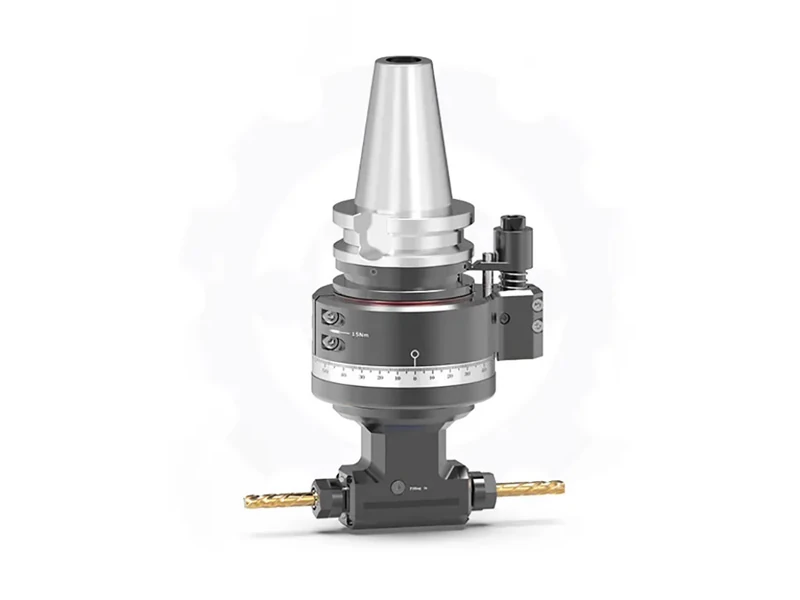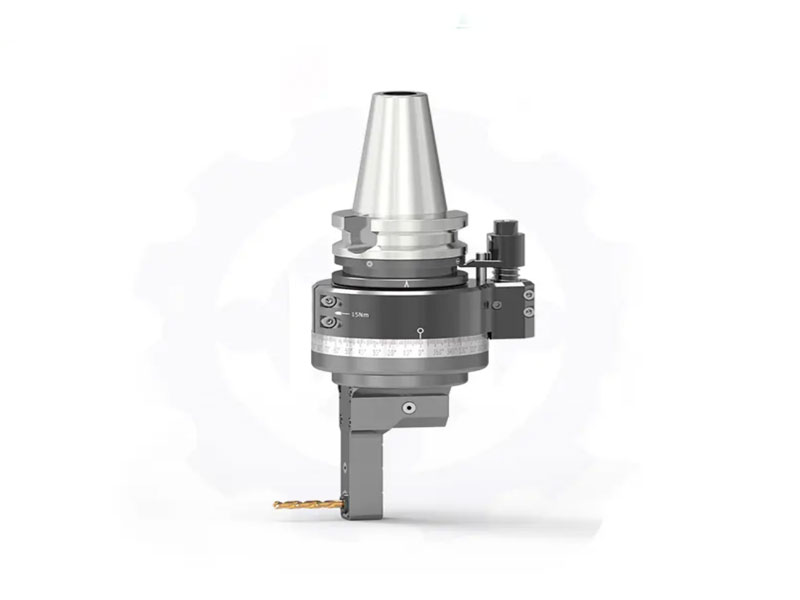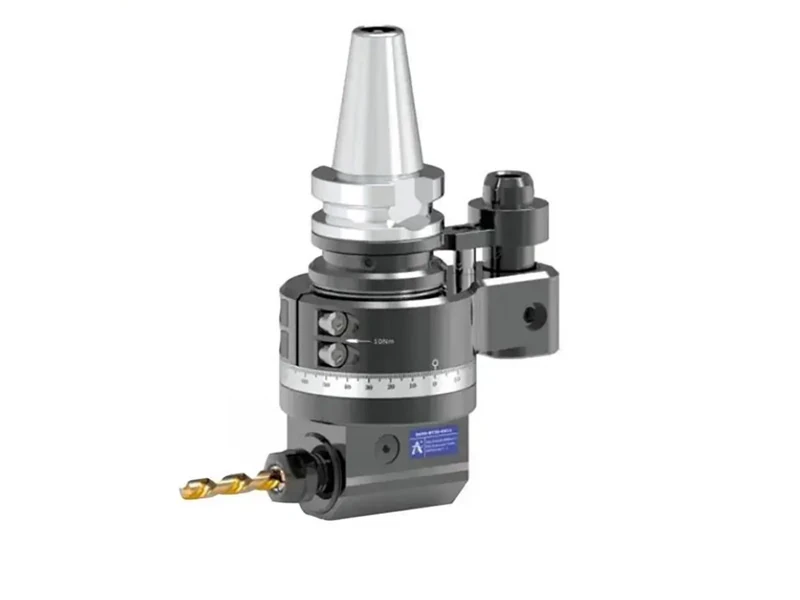
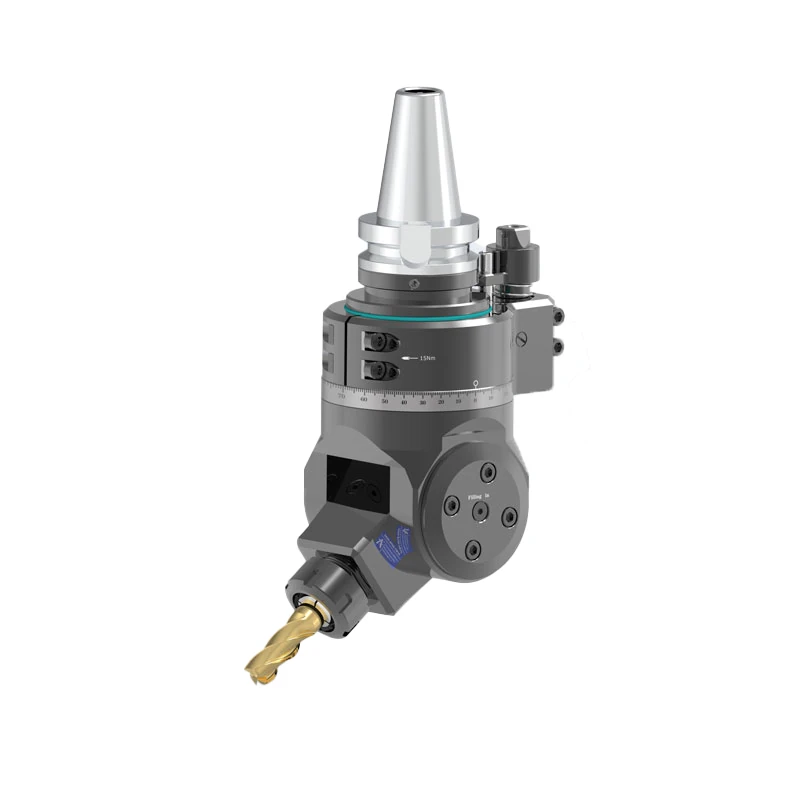
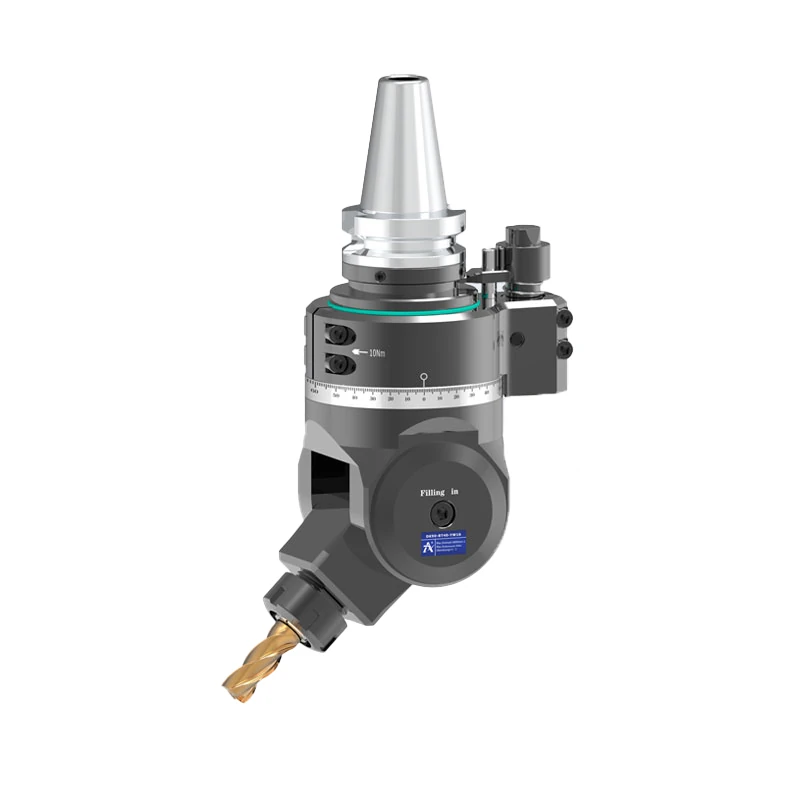
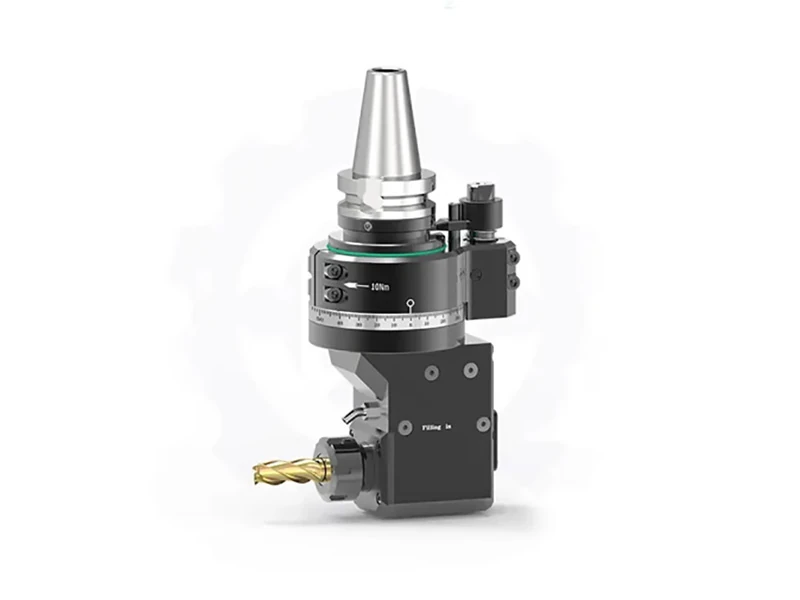

Not every CNC machining operation can be completed with the machine spindle in its standard position. Side holes, deep cavities, and enclosed pockets may require the cutting tool to approach the workpiece from a different direction.
A 90° right angle head changes the tool direction by 90 degrees, allowing a CNC machine to perform side drilling, tapping, and milling without changing the basic spindle arrangement.
However, changing the tool direction is only part of the challenge. In deep or enclosed areas, external coolant may not reach the cutting edge effectively, while chips can be difficult to remove. This can lead to excessive heat, poor chip evacuation, and unstable machining.
A coolant-through right angle head addresses these issues by delivering coolant through internal passages and toward the tool tip. This makes it particularly useful for side machining where tool access, cooling, and chip evacuation all matter.
What Is a Coolant-Through 90° Right Angle Head?
The attachment is mounted to the machine spindle. Its internal gears change the direction of rotation by 90 degrees, allowing the tool to machine from the side. Unlike a conventional right angle head, a coolant-through model has an internal coolant passage that allows cutting fluid to reach the tool end directly.
This design is especially useful when:
- The machine spindle cannot directly access a side hole or surface.
- The workpiece has a deep or enclosed cavity.
- External coolant cannot effectively reach the cutting edge.
- Chips need to be removed continuously from a confined area.
- Side drilling, tapping, or milling is required during production.
In other words, the right angle head solves the tool access problem, while the coolant-through design helps address cooling and chip evacuation.
What Applications Is a Coolant-Through Right Angle Head Used For?
The main applications are areas where conventional spindle access or external coolant delivery is limited.
Side Drilling and Tapping
Side holes often cannot be machined directly with the main spindle. A right angle head changes the tool orientation, allowing the cutter to approach the workpiece from the side.
During drilling and tapping, coolant delivery becomes particularly important when the hole is deep or located inside an enclosed area. Through-spindle coolant can reach the tool more directly and help carry chips away from the cutting zone.
Deep-Cavity and Pocket Milling
Deep cavities, narrow pockets, and enclosed areas can restrict both tool access and coolant flow.
External spray coolant may have difficulty reaching the bottom of the cavity. A coolant-through right angle head delivers coolant through the internal passage and closer to the cutting area, helping control heat and improve chip evacuation.
Mold, Automotive, and Aerospace Machining
Mold, automotive, and aerospace components often contain complex geometries that require machining from different directions.
Materials such as H13, NAK80, S45C, 40Cr, Inconel, and Ti-6Al-4V may also require careful control of heat and chip evacuation during machining.
For these applications, the performance of a right angle head depends not only on whether the tool can reach the required area, but also on how well the machining system manages cooling, chip evacuation, tool life, and dimensional stability.
How Does Through-Spindle Coolant Improve Side Machining?
Through-spindle coolant helps make side machining more stable, especially when working in deep or enclosed areas. Instead of relying only on external spray cooling, coolant is delivered closer to the cutting area through the right angle head. This helps control heat and clear chips more effectively, reducing the load on the cutting tool. As a result, machining can be more consistent, with potential benefits such as longer tool life, better dimensional stability, and fewer production interruptions.
Why Choose the BOD DK90-BT50-ER25-Z80 Right Angle Head?
After understanding how coolant-through right angle heads work and where they are used, the specifications of the BOD DK90-BT50-ER25-Z80 provide a practical example of this design.
This heavy-duty CNC angle head is designed for BT50 vertical and horizontal machining centers and is suitable for side drilling, deep-hole slotting, and heavy milling.
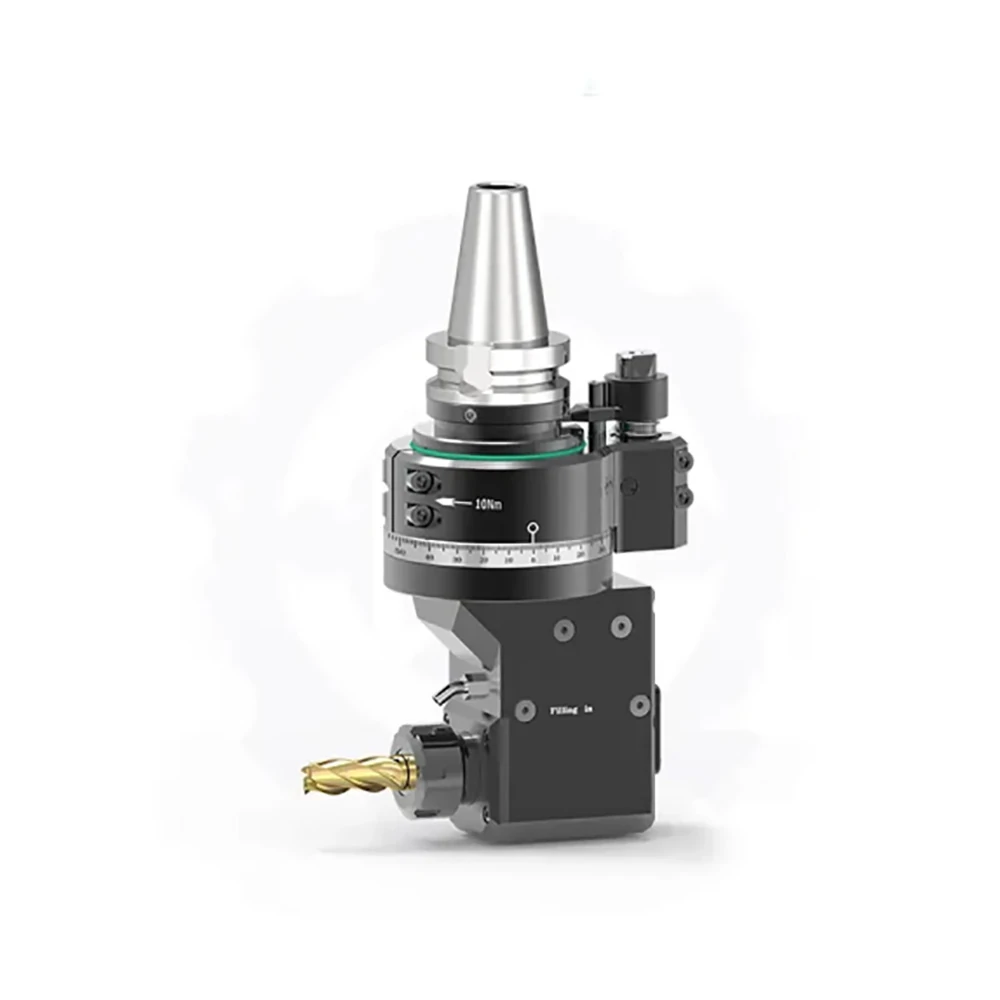
20 Bar Through-Spindle Coolant System
The BOD DK90-BT50-ER25-Z80 supports coolant pressure up to 20 bar (290 PSI).
Coolant is delivered through the internal passage and exits through the ER25 tool nose. This allows high-pressure coolant to reach the cutting area more directly, which is especially useful for deep cavities and enclosed machining areas.
QT500-7 High-Rigidity Housing
The housing is made from QT500-7 ductile cast iron and undergoes artificial aging and cryogenic stress relief.
The heavy-wall housing is designed to provide the rigidity required for demanding machining conditions. This makes the right angle milling head suitable for applications involving heavy cutting and difficult-to-machine materials.
Precision Gears and P4-Class Bearings
The transmission uses Okamoto spiral bevel gears made from 20CrMnTi alloy steel.
The gears are carburized and quenched to HRC 58–62, with ISO Grade 4 accuracy. Backlash is controlled to ≤15 arcmin, while operating noise is ≤70 dB under full load.
The spindle uses P4 preloaded angular contact bearings from NSK or FAG to support high-speed and precision machining.
6,800 RPM and 46.0 Nm Maximum Torque
The BOD DK90-BT50-ER25-Z80 has a maximum speed of 6,800 RPM and maximum torque of 46.0 Nm, with a 1:1 gear ratio.
It uses an ER25 tool interface with a clamping range of Ø1.0–Ø16.0 mm and supports tapping from M6 to M14.
These specifications allow the attachment to handle a range of side drilling, tapping, and milling operations.
Case Study: Side Drilling and Tapping a 40Cr Hydraulic Valve Body
A typical application involved machining a batch of 40Cr hydraulic valve bodies that required multiple side drilling and tapping operations inside an enclosed cavity.
Challenges with Conventional External Coolant
A conventional angle head was used with external spray cooling. Because the cavity restricted coolant access, the cutting edge did not receive sufficient cooling.
The machining process experienced several problems:
- Poor chip evacuation
- Excessive heat and frequent tool burning
- Scratches on threaded surfaces
- Short tool life
- Dimensional fluctuations
- Frequent machine stoppages for chip removal
- Limited production capacity
The main issue was not the ability of the angle head to perform side machining. The problem was that coolant delivery and chip evacuation were difficult inside the enclosed cavity.
Results After Using Through-Spindle Coolant
After switching to a coolant-through angle head, high-pressure coolant was delivered directly toward the cutting edge.
The coolant helped remove heat and flush chips out of the cavity, eliminating chip accumulation and overheating during the operation.
The results included:
- Approximately 40% longer tool life
- More consistent thread surface quality
- Less rework
- No need to reduce the existing cutting parameters
- Shorter machining cycles
- Better suitability for automated continuous production
The case shows why coolant delivery becomes increasingly important as side machining moves into deeper and more enclosed areas.
How Does a BOD Coolant-Through Right Angle Head Compare with Conventional Models?
Both conventional and BOD coolant-through right angle heads can change the tool direction by 90 degrees. The main difference is how they handle coolant and chips during machining.
| Comparison | Conventional Right Angle Head | BOD Coolant-Through Right Angle Head |
| Tool direction | 90° | 90° |
| Coolant delivery | Mainly external spray | Through internal coolant passages |
| Deep-cavity chip evacuation | More limited | Better suited to confined areas |
| Cooling in enclosed areas | Depends on external coolant access | Coolant delivered closer to the cutting area |
| Typical application | General side machining | Deep cavities, enclosed areas, and continuous machining |
Accuracy and service life are also important when selecting a milling angle head for production use.
The BOD DK90-BT50-ER25-Z80 achieves spindle nose runout of ≤0.005 mm, with static and dynamic runout of ≤0.015 mm at 4D distance.
Compared with low-cost domestic angle heads, which may have accuracy around 0.02 mm, the BOD model can achieve accuracy of approximately 0.01 mm under the stated conditions.
Service life is another consideration. Low-cost domestic angle heads may typically have a service life of around six months, while the BOD design can reach approximately one year. Its high-strength housing is also designed to provide greater durability under high-temperature and heavy-duty machining conditions.
Conclusion
A coolant-through 90° right angle head is primarily used for side drilling, tapping, deep-cavity milling, and machining in enclosed areas.
The 90° mechanism solves the tool access problem by changing the cutting direction, while the coolant-through system improves coolant delivery and chip evacuation. This combination makes the design particularly useful when conventional external cooling is not effective enough.
For manufacturers selecting a right angle head or CNC angle head, it is important to look beyond maximum speed and torque. Coolant delivery, chip evacuation, accuracy, rigidity, and service life can have a direct impact on machining stability and long-term production efficiency. BOD provides coolant-through 90° right angle head solutions for side drilling, tapping, deep-cavity milling, and other demanding CNC machining applications. Contact BOD for product specifications and application support.
Related Articles
You May Also Like