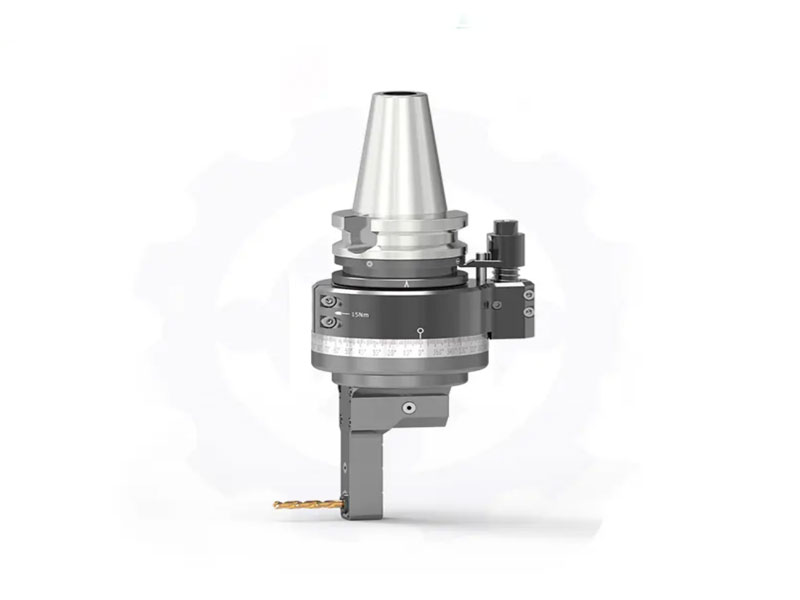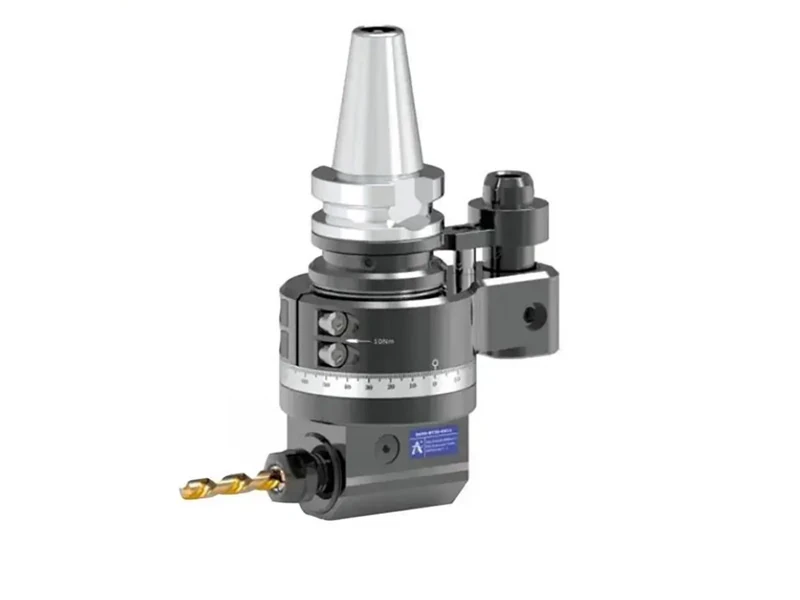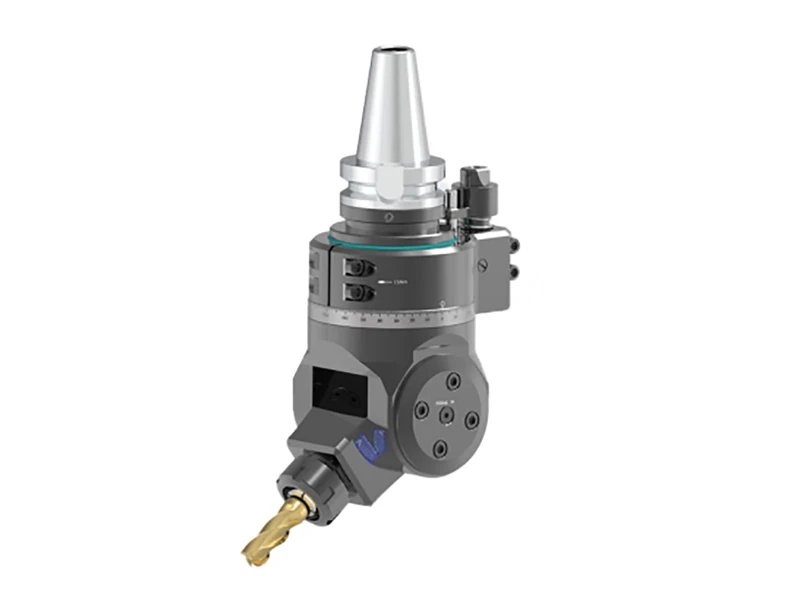
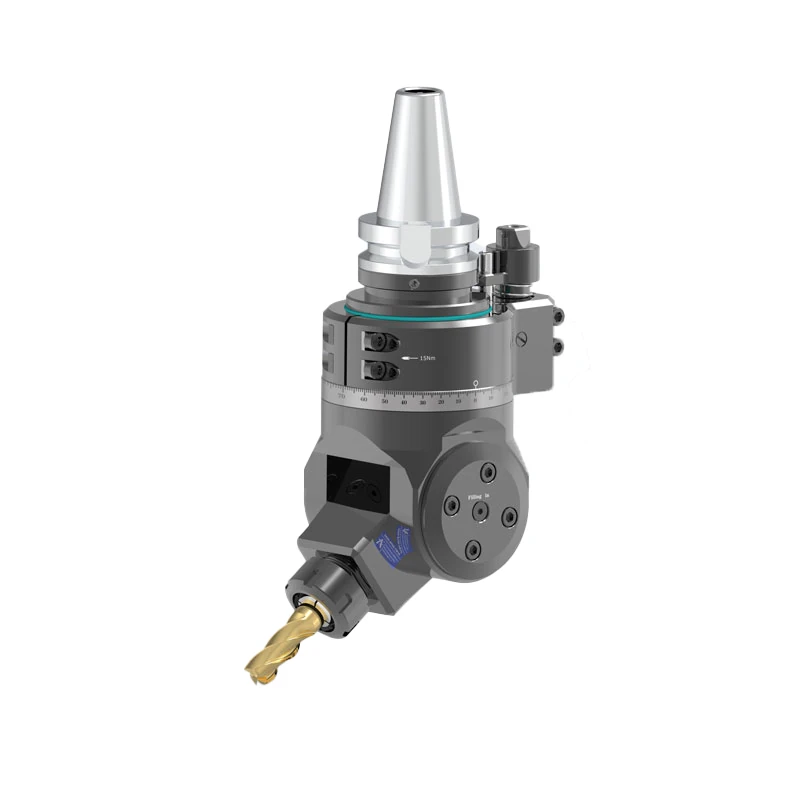
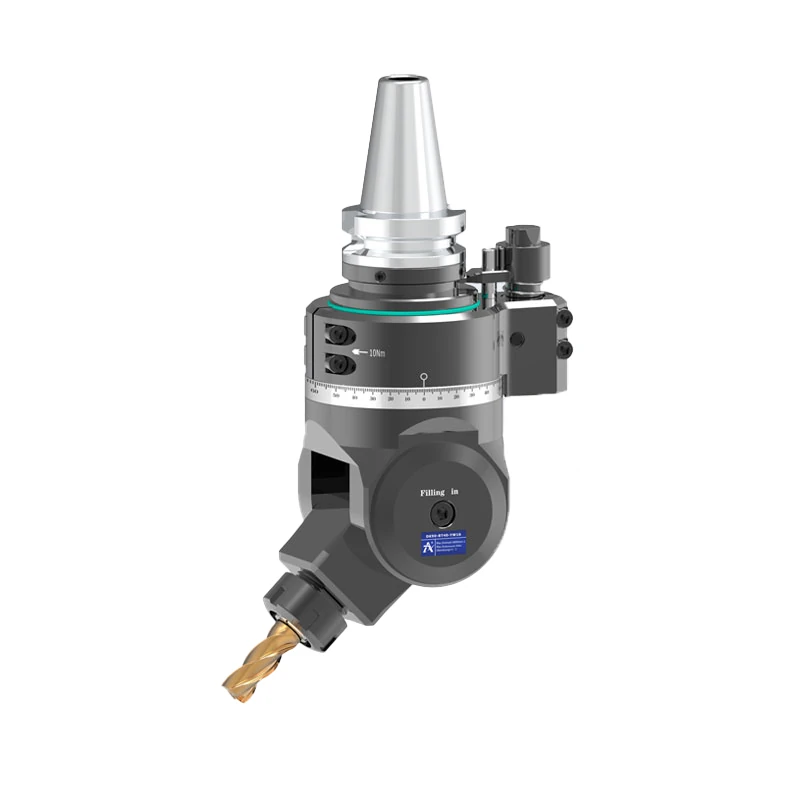

For CNC machining operations that require side milling, drilling, tapping, or machining features in different directions, an angle head can extend what a standard machine spindle can do. Instead of changing the entire machine setup, an angle head redirects the cutting tool so that it can reach features that are not aligned with the main spindle.
A double-output angle head takes this concept further by providing two tool outputs in opposite directions. This can be useful when a workpiece has machining features on two opposing sides and the manufacturer wants to reduce re-clamping, setup time, and positioning errors.
This guide explains how double-output angle heads work, where they are used, what to consider when selecting one, and how the DK90-BT50-2X Series is designed for heavy-duty CNC machining.
What Is a Double-Output Angle Head for CNC Machines?
What Does an Angle Head Do?
An angle head is a CNC machine tool attachment that changes the direction of the cutting tool relative to the machine spindle. A 90 degree angle head redirects the tool axis by 90 degrees, allowing the machine to perform machining operations on the side of a workpiece rather than only along the main spindle direction.
This is useful when a workpiece contains side walls, internal features, slots, holes, or other surfaces that are difficult to reach with a conventional spindle configuration. Angle heads can therefore help manufacturers machine additional features without changing the basic machine setup.
How Does a Double-Output Angle Head Work?
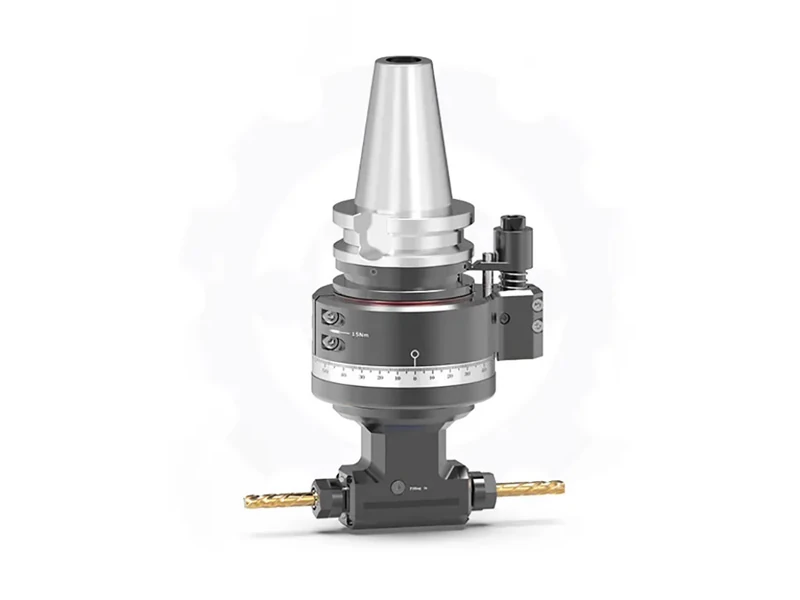
A double-output angle head has two tool outputs positioned on opposite sides of the head. In a typical 180-degree configuration, the two outputs face in opposite directions, allowing two tools to be mounted at the same time.
For example, one output can hold an end mill while the other holds a drill or tap. By indexing the machine spindle or using the appropriate machine-axis movement, the operator can access different sides of the workpiece without changing the tool in the angle head.
This configuration can reduce non-cutting time when several operations are required in different directions. It is particularly useful for workpieces where repeated tool changes or re-clamping would otherwise be necessary.
Double-Output vs. Single-Output Angle Heads
A single-output angle head provides one cutting direction at a time. A double-output design provides two opposing tool positions, making it better suited to applications that involve two sides or multiple sequential operations.
The main advantage is not simply having two tools. The greater benefit comes from reducing unnecessary setup work. When a large workpiece needs machining on opposite sides, fewer re-clamping operations can help reduce positioning errors and improve consistency between machined features.
Benefits of Using a Double-Output Angle Head
Reduce Setup Time and Re-Clamping
Large workpieces are often difficult to reposition accurately. Every additional clamping and alignment operation takes time and introduces another opportunity for positioning errors.
A double-output angle head can allow operators to access opposing machining surfaces from one setup. This can reduce workpiece handling and make the overall machining process more efficient.
Improve Machining Accuracy and Consistency
When a workpiece is repeatedly removed, turned, and re-aligned, accumulated positioning errors can affect the relationship between features on different surfaces.
Keeping the workpiece in one setup can help maintain the positional relationship between machined surfaces. For applications such as large molds and automotive components, this can be particularly important where side-wall dimensions and hole positions need to remain consistent.
Applications of Double-Output Angle Heads
Mold and Die Manufacturing
Large molds and dies often contain side walls, slots, holes, and other features that are difficult to machine from the main spindle direction. A double-output configuration can help access opposing surfaces while reducing the need to turn and re-clamp the workpiece.
Automotive Manufacturing
Automotive components such as engine blocks, transmission housings, and large stamping dies can require machining from several directions. Double-output angle heads can support side milling, drilling, tapping, and other sequential operations.
Aerospace and Large-Part Machining
Large aerospace components and other oversized workpieces may contain features distributed across different surfaces. In these applications, reducing repositioning can be valuable because handling and re-alignment become more difficult as workpiece size increases.
How to Choose the Right Angle Head for a CNC Mill
Check the Machine Spindle Interface
The first consideration is compatibility with the CNC machine spindle. The angle head must match the machine’s spindle interface and physical installation requirements.
For large CNC machines, common interfaces include BT50, BBT50, SK50, CAT50, and HSK100A. Buyers should also confirm the required positioning block and G-dimension before ordering.
Match Speed, Torque and Tool Capacity
The angle head should match the cutting conditions and tools used in the application. Maximum spindle speed, available torque, tool clamping range, and tapping capacity are important specifications.
For heavy cutting, torque and rigidity may be more important than simply choosing the highest-speed model.
Consider Accuracy, Rigidity and Service Life
Runout, housing rigidity, bearing support, gear quality, and sealing all affect long-term machining performance. For demanding applications, buyers should also ask how the manufacturer tests the angle head before shipment.
A suitable CNC angle head should not only meet the required cutting parameters but also provide stable performance over the expected operating period.
DK90-BT50-2X Heavy-Duty Double-Output 90 Degree Angle Head
The DK90-BT50-2X Series is a heavy-duty double-output 90 degree angle head developed for BT50 vertical machining centers, horizontal machining centers, and gantry milling machines.
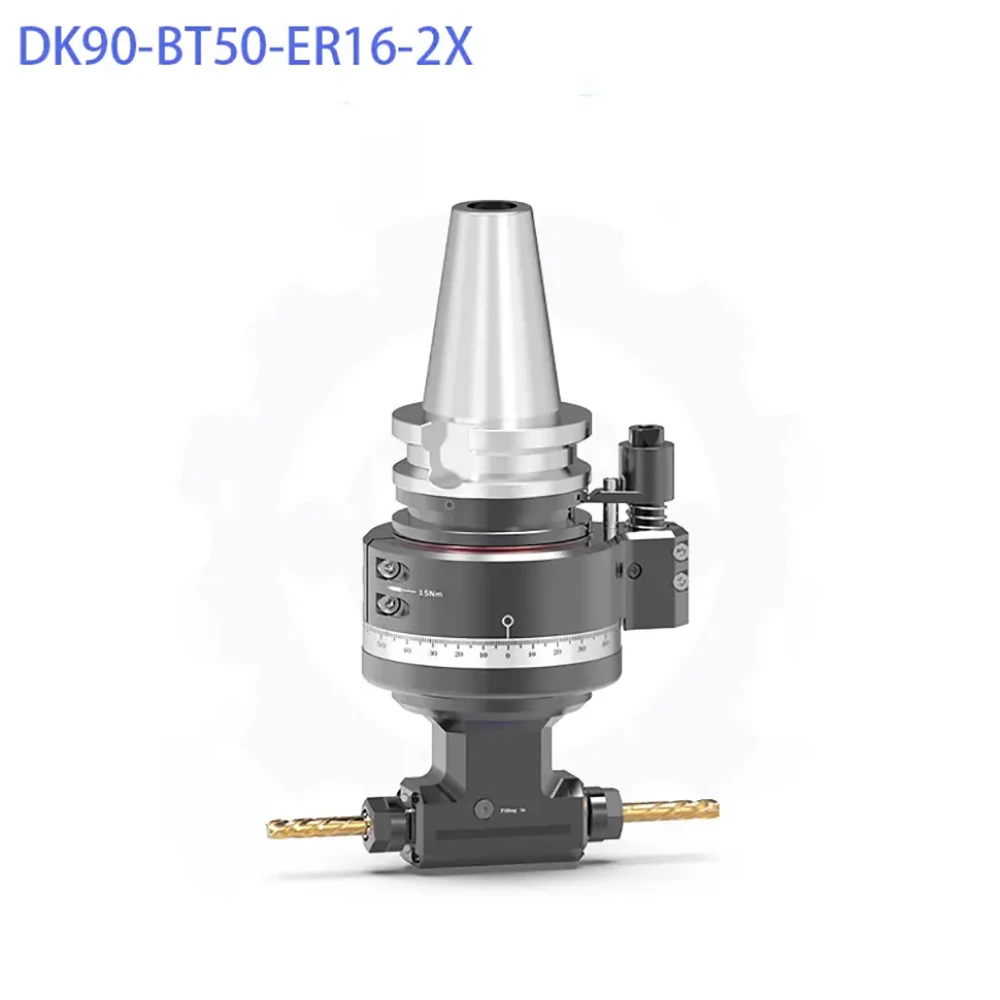
The series includes DK90-BT50-ER16-2X, DK90-BT50-ER25-2X, DK90-BT50-ER25-2X-110, and DK90-BT50-ER32-2X models.
The two output spindles are arranged 180 degrees apart. Depending on the model, the head provides tool clamping from Ø1.0 to Ø20.0 mm and maximum torque from 19.0 to 65.0 Nm.
Coaxial Dual-Output Design for Synchronized Machining
One of the key design features is the integrated coaxial shaft structure. The two output shafts are combined into a common-axis design rather than operating as two independent output arrangements.
According to the product design, this structure improves the symmetry of the two outputs, reduces asynchronous runout and vibration interference, and helps maintain accuracy and stability during extended machining.
This design improves on conventional split dual-output angle heads. It is well suited to applications where the two machining directions need to stay closely aligned.
QT500-7 Housing for High Rigidity
The housing is made from QT500-7 ductile iron and is designed to provide high rigidity and long-term structural stability.
The symmetrical heavy-wall housing helps balance cutting forces during dual-sided machining. The casing also undergoes artificial aging and stress-relief treatment to improve structural stability.
For heavy-duty machining of materials such as mold steel, this rigid housing is intended to provide a stable foundation for the internal transmission and output spindle system.
Precision Gear and Bearing System
The DK90-BT50-2X Series uses precision-ground spiral bevel gears made from 20CrMnTi alloy steel. The gears are carburized and quenched to HRC 58–62 and ground to ISO Grade 4 precision.
The transmission backlash is controlled to ≤15 arcmin, while operating noise is specified at ≤70 dB under full load.
Both output shafts use preloaded P4-class angular contact ball bearings. The bearing arrangement supports high-speed rotation and cutting loads, while the sealing design helps protect the internal components from dust and water.
The specified spindle nose runout is ≤0.005 mm on both output ends.
Modular Design for Easier Maintenance
The output shaft assembly can be removed as a complete unit. This modular design makes maintenance and adjustment more convenient, including adjustment of the bevel gear clearance.
For B2B users, this can simplify maintenance work when the angle head is used regularly in production environments.
DK90-BT50-2X Series Specifications
| Model | Output | Max. Speed | Clamping Range | Tapping Capacity | Max. Torque | Weight |
| DK90-BT50-ER16-2X | ER16 × 2 | 8,000 RPM | Ø1–10 mm | M5–M8 | 19.0 Nm | 10.000 kg |
| DK90-BT50-ER25-2X | ER25 × 2 | 6,800 RPM | Ø1–16 mm | M6–M14 | 46.0 Nm | 12.579 kg |
| DK90-BT50-ER25-2X-110 | ER25 × 2 | 6,800 RPM | Ø1–16 mm | M6–M14 | 46.0 Nm | 12.109 kg |
| DK90-BT50-ER32-2X | ER32 × 2 | 5,000 RPM | Ø1–20 mm | M6–M16 | 65.0 Nm | 14.526 kg |
All four models use a 1:1 gear ratio. The ER16 and ER32 models use CW-CW rotation, while the ER25 models provide the specified left and right rotation configurations.
CNC Machine Compatibility
The DK90-BT50-2X Series is designed for large VMC, HMC, and gantry milling machines.
BT50, BBT50, SK50, CAT50 and HSK100A Interfaces
The compatible spindle standards include BT50, BBT50, SK50, CAT50, and HSK100A. The required spindle interface and positioning arrangement should be confirmed before ordering.
VMC, HMC and Gantry Milling Machines
The series is intended for large CNC machine tools, with typical compatible brands including Mazak, Haas, Okuma, Doosan/DN Solutions, Makino, and JTEKT/Toyoda.
Application Case: Large Automotive Stamping Die Machining
A mold manufacturer was machining a large automotive stamping die made from P20 mold steel. The workpiece contained side-wall surfaces, corner-clearance slots, and multiple mounting threaded holes on both sides.
With the conventional process, the workpiece had to be turned and re-clamped several times. Each repositioning operation required additional alignment work and could introduce accumulated positioning errors.
The manufacturer used a BT50 double-output angle head with a gantry machining center. The workpiece remained clamped in one position while the two output ends were used to machine the left and right side features in sequence, including side milling, corner clearing, drilling, and tapping.
The solution reduced the number of setup operations by three and shortened the overall machining cycle by approximately 35%. It also reduced subsequent fitting and grinding work and improved dimensional consistency between the two sides of the mold.
Quality Control and Testing
Dual-Spindle Runout Inspection
Every DK90-BT50-2X Series unit undergoes a 100% inspection before shipment. Runout is checked independently at both output ends. Spindle nose runout is controlled to ≤0.005 mm, with the specified runout at 4D distance limited to ≤0.015 mm.
Continuous Run-In Testing
Each unit is tested continuously at full rated speed for 60 minutes. The housing temperature rise must remain within 25°C above ambient temperature across both gear outputs.
Gear Backlash and Alignment Inspection
Angular encoders are used to verify the gear transmission and confirm backlash remains within 15 arcmin on both drive ends.
ISO 9001:2015 Quality Management
The manufacturer operates under an ISO 9001:2015 quality management system, providing a defined framework for quality control and production processes.
Accuracy and Service Life of the DK90-BT50-2X
Machining Accuracy up to 0.01 mm
The product’s accuracy control can reach 0.01 mm, compared with approximately 0.02 mm for the low-end domestic angle heads identified in the supplied product comparison.
Service Life of Up to One Year
The expected service life of the DK90-BT50-2X is up to one year, compared with approximately six months for the low-end domestic models in the same comparison.
For production users, service life should be evaluated together with cutting conditions, operating frequency, maintenance, and application requirements rather than as a standalone specification.
Packaging, Shipping and Delivery
Anti-Rust and Shock Protection
Each unit is protected with heavy-duty anti-rust oil and vacuum-sealed in a VCI bag with industrial desiccant. Protective foam is used to reduce transport shock to the output spindles and BT50 taper.
Export Packaging for Heavy-Duty Angle Heads
Because the units weigh up to 14.526 kg, they are packed in ISPM 15-compliant fumigation-free plywood cases with reinforced metal edge locks.
Lead Time and Shipping Options
Standard models are normally shipped within 5–7 working days, while customized positioning blocks require approximately 15–20 working days.
FOB, CIF, EXW, FCA, DDU, and DDP terms are supported, with Shanghai, Ningbo, and Tianjin available as shipment ports.
Conclusion: Is a Double-Output Angle Head Right for Your CNC Application?
A double-output angle head can be a practical solution when a CNC machining process requires access to opposing surfaces, multiple side operations, or fewer workpiece setups. The main selection factors are machine compatibility, tool capacity, speed, torque, rigidity, accuracy, maintenance, and expected service life.
For large molds, automotive components, and other heavy-duty applications, the DK90-BT50-2X Series combines a BT50 interface, 180-degree dual output, coaxial shaft design, QT500-7 housing, precision transmission, and dual-spindle inspection. Its four models provide different speed, clamping, and torque ranges for different machining requirements.
For buyers evaluating a CNC angle head, the most suitable configuration should ultimately be determined by the machine spindle, workpiece geometry, cutting tools, and actual machining conditions. If you are looking for a double-output angle head for your CNC machine, contact us to discuss your machine configuration and machining requirements. Our team can help you identify a suitable DK90-BT50-2X Series model for your application.
Related Articles
You May Also Like