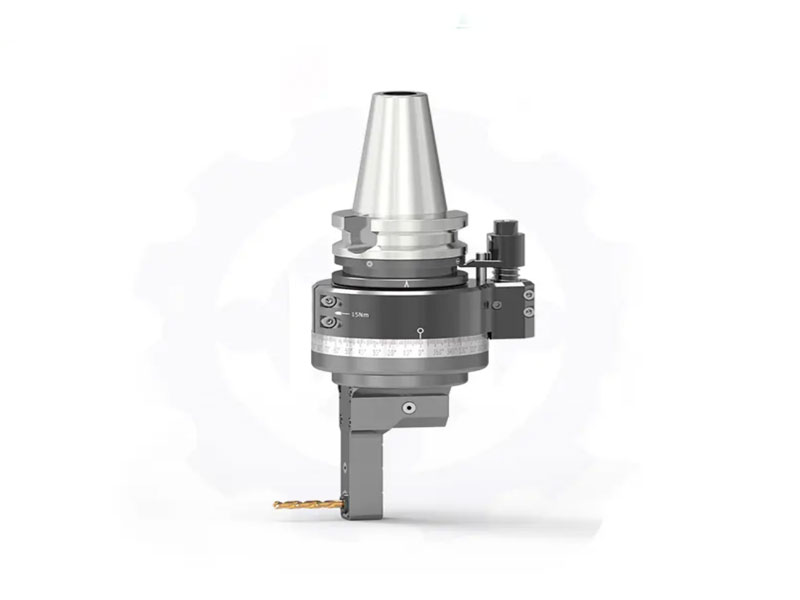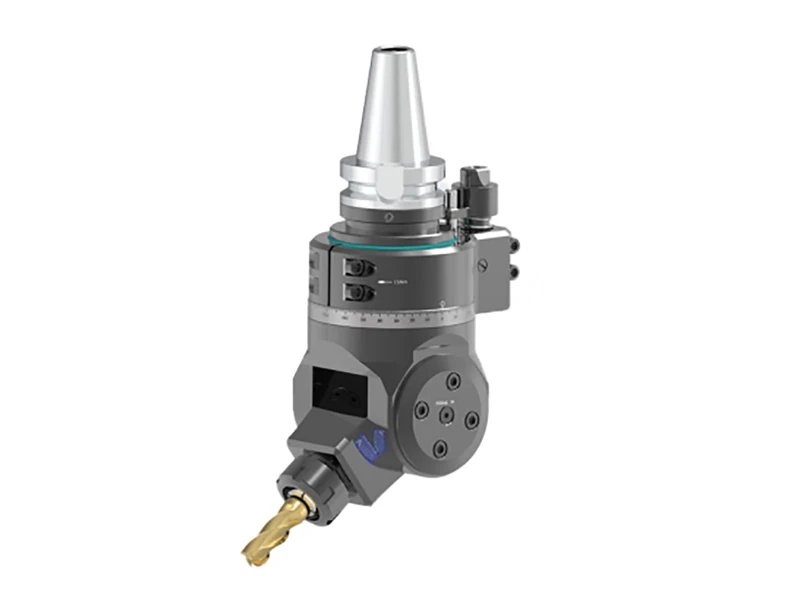
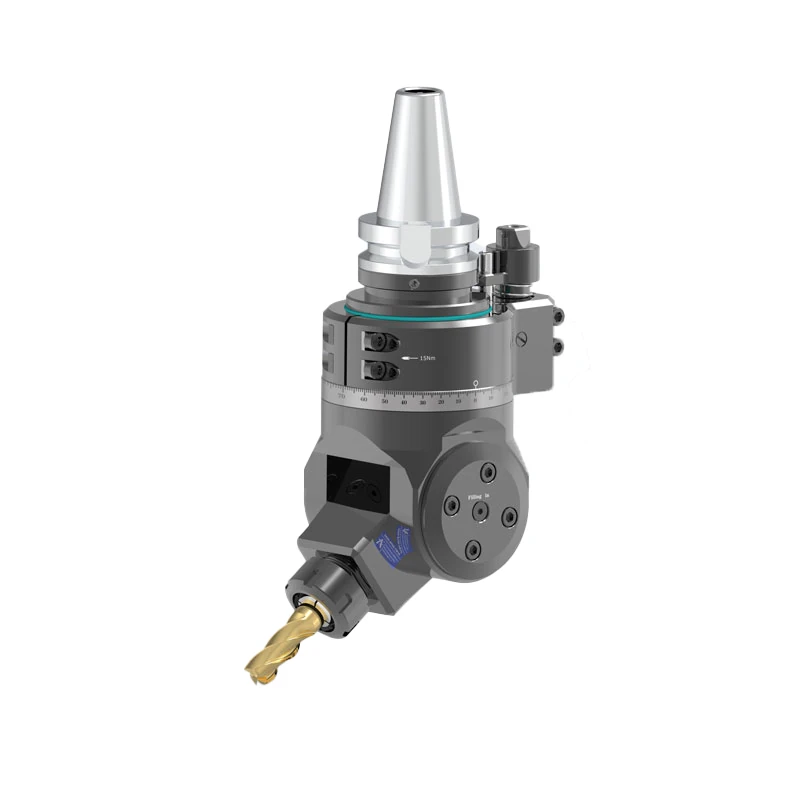
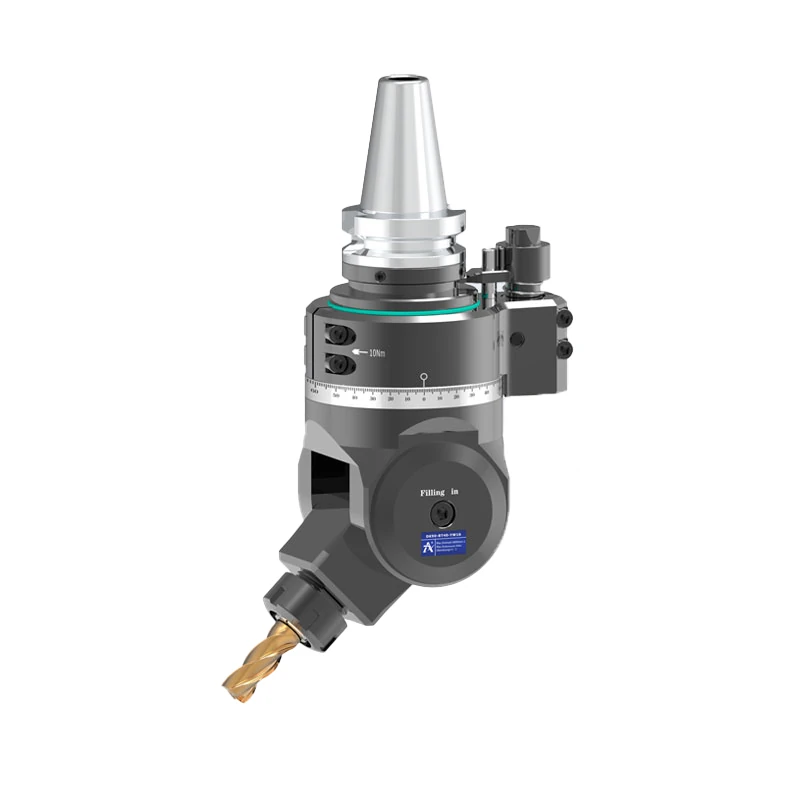
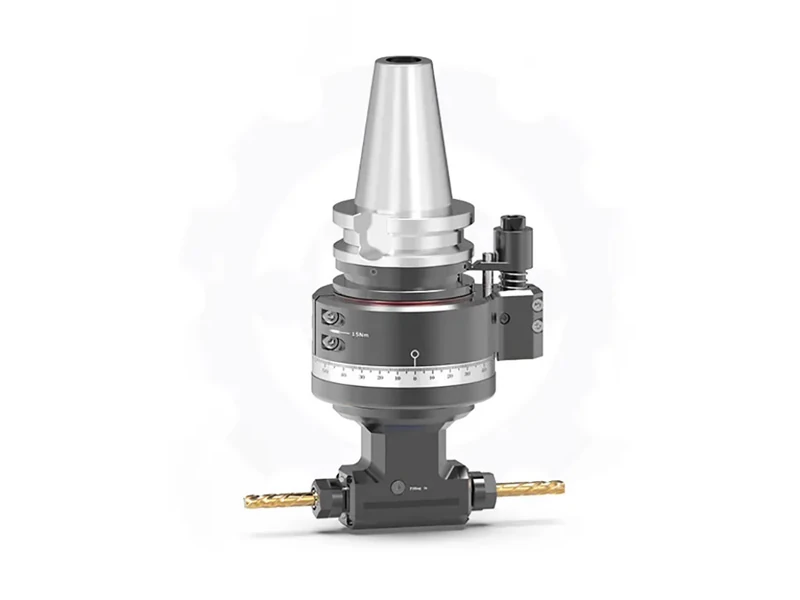

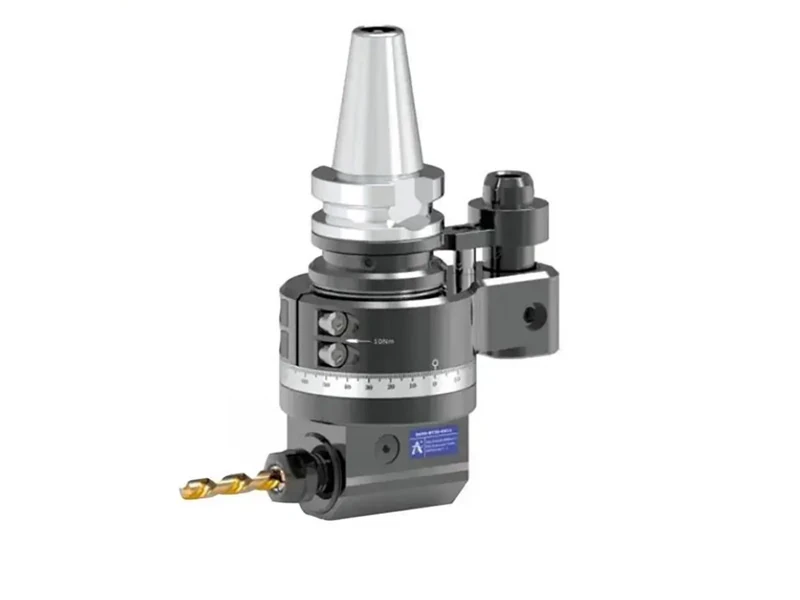
When a CNC machining center needs to process holes, slots, or threads on the side of a workpiece, the machine spindle may not always provide the required access. A 90 degree angle head can change the spindle direction by 90 degrees, allowing side machining without changing the basic machine configuration.
For manufacturers using BT30 machining centers, choosing the right angle head requires more than checking the maximum RPM. Spindle compatibility, tool size, torque, runout, weight, clearance, service life, and the type of machining all affect whether an angle head is suitable for production.
This guide explains the main factors to consider before purchasing a 90-degree angle head for a BT30 CNC machine.
What Is a 90 Degree Angle Head for a BT30 CNC Machine?
A 90-degree angle head is a CNC machining attachment that transfers spindle rotation to an output spindle positioned at a right angle to the machine spindle. This allows tools to approach a workpiece from the side.
Instead of removing and repositioning a workpiece to access another surface, manufacturers can use an angle head to perform additional machining operations within the same clamping setup.
How Does a 90 Degree Angle Head Work?
The machine spindle drives the angle head through its input shank. Inside the head, a gear transmission changes the direction of rotation by 90 degrees and transfers it to the output spindle.
The design therefore needs to maintain both rotational stability and positional accuracy. Gear quality, bearing configuration, spindle runout, and backlash all affect the machining result.
What Machining Operations Can a 90 Degree Angle Head Handle?
The appropriate application depends on the model and cutting conditions, but typical operations include:
- Side milling
- Side drilling
- Cross-hole machining
- Lateral thread processing
- Tapping
- Machining features that are difficult to reach with the standard vertical spindle
This makes an angle head useful when several surfaces of a component need to be machined without repeatedly changing the workholding arrangement.
When Should You Use a Right Angle Head for CNC Mill Applications?
A right angle head for CNC mill applications is particularly useful when the workpiece requires side machining but the machine itself is primarily configured for vertical machining.
It can be considered when:
- Side features are difficult to access with the standard spindle.
- Repeated reclamping could affect positioning accuracy.
- Multiple operations need to be completed on the same workpiece.
- The machine has limited space and a compact attachment is preferred.
- The required cutting tools are compatible with the angle head.
For high-value parts, reducing unnecessary reclamping can also help reduce the possibility of positioning errors.
8 Key Factors to Consider When Choosing a BT30 Right Angle Head
Once the application has been identified, the next step is to compare the technical requirements of the machine and the angle head.
1. Check BT30 and BBT30 Spindle Compatibility
The first consideration is the machine spindle interface.
A BT30 right angle head should match the spindle standard of the machining center. Compatibility should also include the automatic tool changer. The angle head needs sufficient clearance for the ATC mechanism to grab, seat, and release the tool holder correctly.
2. Match the Spindle Output to Your Cutting Tools
The output spindle determines which tools can be clamped.
ER collets are available in different sizes, so the required tool diameter should be established before selecting the angle head. Smaller ER sizes are suitable for smaller cutting tools, while larger ER sizes provide a wider clamping range and higher torque capacity.
For example, an application involving small medical components may require a smaller output such as ER11, while applications requiring larger tools may benefit from ER20 or ER25.
3. Choose the Right RPM and Torque
Maximum spindle speed and torque should be considered together.
High-speed machining with small tools may prioritize RPM, while drilling or tapping with larger tools may require more torque.
The required specifications should therefore be compared with:
- Tool diameter
- Material being machined
- Milling or drilling operation
- Tapping size
- Required cutting speed
Choosing a head solely because it has the highest RPM may not result in the best solution for the actual application.
4. Consider Gage Length and Machine Clearance
The physical dimensions of the angle head can directly affect accessibility.
Gage length determines how far the output spindle extends from the machine spindle, while the overall diameter affects clearance around the workpiece and fixture.
Before purchasing, check the angle head dimensions against the machine’s working envelope, fixture, workpiece geometry, and surrounding components.
A longer configuration may provide additional reach, but a compact configuration can be preferable where clearance is limited.
5. Evaluate Runout and Transmission Accuracy
Accuracy is one of the most important factors when selecting a cnc angle head.
Spindle runout affects the actual position of the cutting tool, while transmission backlash can affect the consistency of angular movement and machining performance.
When comparing suppliers, ask for specific measurement data rather than relying only on general descriptions such as “high precision.”
6. Check Weight and ATC Compatibility
Weight is particularly important for compact BT30 machining centers equipped with an automatic tool changer.
A heavy angle head can place additional demands on the ATC arm and spindle retention mechanism. A lightweight design can therefore be advantageous where machine payload and tool-changing conditions are limited.
The angle head should also be tested through the machine’s ATC cycle before production use.
7. Compare Service Life and Housing Materials
Purchase price is only one part of the cost of an angle head. Expected service life can also affect replacement frequency and production planning.
Housing material is another consideration. A high-strength housing needs to maintain rigidity while withstanding the operating environment. For applications involving long production cycles or temperature variation, manufacturers should ask suppliers about the housing material and durability testing.
8. Consider Quality Control and Manufacturer Support
A supplier should be able to provide clear information about inspection procedures, technical specifications, and machine compatibility.
Important items include:
- Spindle runout inspection
- Gear and transmission testing
- Continuous run-in testing
- Backlash verification
- ATC compatibility
- Technical drawings and CAD data
- Lead time and shipping arrangements
These details can be particularly important for B2B buyers purchasing multiple units for production.
How to Choose the Right ER Size for a 90 Degree Angle Head
ER size should be selected according to tool diameter, tapping requirements, torque, and the available machining space.
ER11 for Micro-Machining and Small Medical Components
ER11 is suitable when small cutting tools are required.
For applications involving small holes, fine side milling, or smaller tapping sizes, the smaller collet system can provide an appropriate tool-holding solution.
ER16 for Precision Drilling, Milling, and Tapping
ER16 provides a broader clamping range than ER11 while maintaining a relatively compact configuration.
It can be considered when the machining process requires tools within the Ø1.0–Ø10.0 mm range and tapping from M4 to M8.
ER20 and ER25 for Higher Torque Applications
When larger tools or higher tapping capacities are required, ER20 and ER25 provide greater capacity.
The appropriate choice should be based on the actual tool diameter and machining load rather than simply selecting the largest available collet.
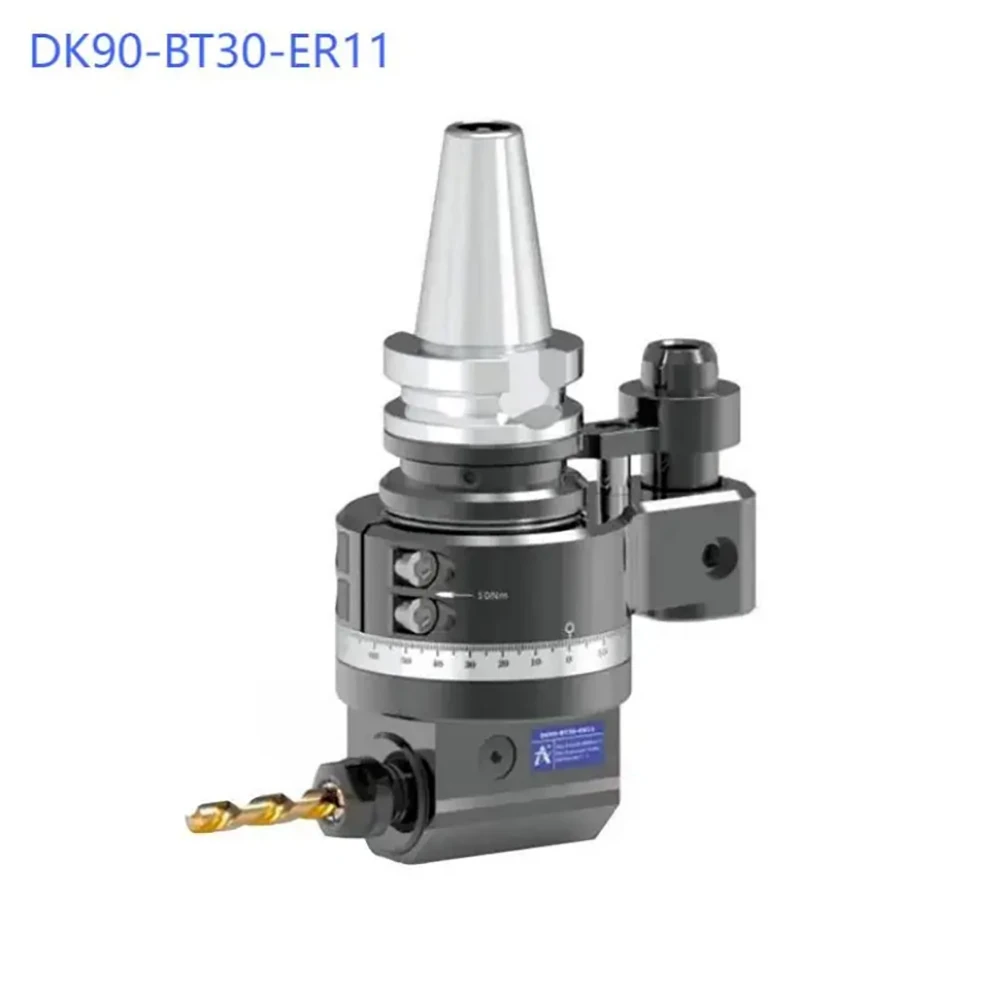
DK90-BT30 ER Series: Compact 90° Angle Head for BT30 CNC Machines
Based on the selection criteria discussed above, the DK90-BT30 ER Series is designed for manufacturers that need a compact solution for light-to-medium side milling, drilling, and tapping on BT30 vertical machining centers and high-speed CNC tapping centers.
By changing the spindle direction by 90 degrees, the angle head provides access to side features without requiring the workpiece to be repeatedly removed and repositioned. For precision components, this can help reduce setup-related positioning errors while making multi-side machining more efficient.
The DK90-BT30 ER Series combines a high-strength aviation-aluminum housing, precision-ground spiral bevel gears, preloaded P4-grade bearings, and five ER spindle configurations from ER11 to ER25.
High-Strength Aviation-Aluminum Housing
The housing is made from high-strength aviation aluminum, providing a balance of rigidity, precision, and durability while keeping the angle head lightweight.
Depending on the model, the net weight ranges from 1.504 kg to 2.800 kg. This lightweight construction is particularly suitable for compact BT30 machining centers, where the weight of an accessory can affect ATC handling and spindle loading.
The high-strength housing is also designed for long-term use and provides improved durability under extreme temperature conditions compared with lower-end angle head designs.
OKAMOTO Precision-Ground Spiral Bevel Gears
The transmission system uses OKAMOTO precision-ground spiral bevel gears made from 20CrMnTi alloy steel.
The gears are heat-treated to HRC 58–62 and ground to ISO Grade 4 precision. The 1:1 gear ratio transfers spindle rotation directly to the output spindle, while the specified transmission backlash is ≤15 arcmin.
Operating noise is specified at ≤70 dB at rated RPM.
These specifications are relevant because the gear system directly affects how consistently rotational power is transferred during side milling, drilling, and tapping.
Preloaded P4-Grade Precision Bearings
The spindle is supported by preloaded P4-grade angular contact ball bearings from NSK/FAG.
The specified spindle nose runout is ≤0.005 mm, with runout at a 4D distance limited to ≤0.015 mm.
For precision machining, lower runout helps keep the cutting tool closer to its intended position during rotation. This is particularly important when machining small holes, narrow slots, or other features where tool stability can affect the finished part.
Five ER Output Configurations
The DK90-BT30 ER Series is available in five configurations, allowing buyers to select the output according to tool diameter, tapping requirements, torque, and available machining space.
| Model | Max. Speed | Clamping Range | Tapping Capacity | Max. Torque | Net Weight |
| DK90-BT30-ER11 | 8,000 RPM | Ø1.0–Ø7.0 mm | M4–M6 | 10.8 Nm | 1.661 kg |
| DK90-BT30-ER16 | 8,000 RPM | Ø1.0–Ø10.0 mm | M4–M8 | 18.0 Nm | 1.504 kg |
| DK90-BT30-ER16L | 8,000 RPM | Ø1.0–Ø10.0 mm | M4–M8 | 18.0 Nm | 1.851 kg |
| DK90-BT30-ER20 | 7,500 RPM | Ø1.0–Ø13.0 mm | M5–M10 | 30.0 Nm | 2.400 kg |
| DK90-BT30-ER25 | 6,800 RPM | Ø1.0–Ø16.0 mm | M6–M14 | 46.0 Nm | 2.800 kg |
The differences between the models are mainly related to tool capacity and torque.
The ER11 model supports tools from Ø1.0–Ø7.0 mm and M4–M6 tapping, making it suitable for small-tool machining. ER16 expands the clamping range to Ø10.0 mm, while ER20 and ER25 provide higher maximum torque for applications requiring larger tools or higher tapping capacity.
The ER16L uses the same ER16 clamping range but has a 74 mm gage length, compared with 28 mm for the standard ER16. This provides an option when additional reach is required.
Precision and Service Life for Production Applications
For manufacturers purchasing an angle head for regular production, precision and service life are important considerations alongside the initial purchase price.
The manufacturer reports that the DK90 series can achieve precision down to 0.01 mm, while some entry-level angle heads may be around 0.02 mm. The difference is small numerically, but for precision components, a tighter accuracy level can be relevant when machining small features and maintaining dimensional consistency.
The manufacturer also reports a service life of up to one year for the DK90 series, compared with around six months for some lower-cost angle heads.
A longer service interval can reduce the frequency of replacement and help minimize interruptions associated with equipment changeover, installation, and production planning. Actual service life will depend on the machining conditions, operating speed, cutting load, and maintenance practices.
100% Inspection and Quality Control
Every DK90-BT30 ER Series unit undergoes a 100% quality inspection before packaging.
The inspection process includes:
- Static and dynamic spindle runout testing
- A 60-minute continuous run-in test
- Anti-backlash calibration
- Verification of spindle and transmission accuracy
During the 60-minute run-in at rated operating speed, the housing temperature rise must remain ≤25°C above ambient temperature. This test helps verify lubrication and gear-meshing performance before shipment.
The manufacturer operates under an ISO 9001:2015 quality management system.
DK90-BT30-ER11 Medical Component Machining Case
A medical precision-component manufacturer uses the DK90-BT30-ER11 to process small titanium and stainless-steel components for orthopedic and minimally invasive instruments.
The parts require side milling, cross drilling, and M4–M6 tapping. Before adopting the angle head, the customer needed to repeatedly remove and reclamp each workpiece to access the side features.
This process increased machining time and created additional opportunities for positioning deviations. For high-value medical components, minimizing these setup-related risks is particularly important.
The customer installed the DK90-BT30-ER11 on a BT30 machining center. With a maximum speed of 8,000 RPM and a 1:1 gear ratio, the angle head allows the required side operations to be completed within one clamping setup.
By reducing repeated reclamping, the solution helps minimize positioning errors and improves efficiency in batch production of small medical components.
Frequently Asked Questions About 90 Degree Angle Heads
Can a 90 Degree Angle Head Be Used With My CNC Machine?
A 90 degree angle head can be matched to different CNC machine spindle interfaces, including BT, SK, HSK, CAT, CAPTO, and NT. The exact configuration depends on the machine spindle specification. For special machine configurations, customized interface solutions can also be provided.
Can I Run a 90 Degree Angle Head at the Same Speed as My CNC Machine Spindle?
No. The angle head must always be operated within its specified maximum speed. If the CNC machine spindle speed exceeds the rated speed of the angle head, excessive friction and heat can occur inside the gears and bearings, potentially causing premature wear, gear damage, seizure, or loss of machining accuracy. In severe cases, excessive operating speed may also cause damage to the machine or workpiece.
For the DK90-BT30 ER Series, the maximum speed varies by model from 6,800 to 8,000 RPM. The selected angle head should therefore be matched to the actual spindle speed and machining requirements.
What Is the Difference Between Tapping Capacity and Drill Diameter?
Tapping capacity and drill diameter refer to two different machining dimensions. Tapping capacity indicates the thread size that the angle head can be used to produce, such as M4–M8. Drill diameter refers to the diameter of the hole drilled before tapping.
For example, an M8 thread normally requires a smaller pre-drilled hole rather than an 8 mm hole. The exact hole diameter depends on the thread specification and pitch. Therefore, an angle head’s tapping capacity should not be interpreted as its maximum drilling diameter.
Conclusion
Choosing a milling angle head should start with the machining requirement rather than the product price. BT30 compatibility, tool size, torque, RPM, runout, clearance, weight, service life, and ATC compatibility all need to be considered together.
For manufacturers requiring side milling, drilling, or tapping on compact BT30 machining centers, the DK90-BT30 ER Series provides five ER configurations, aviation-aluminum construction, precision-ground gear transmission, P4-grade bearings, and documented inspection procedures.
Selecting the correct configuration based on the actual workpiece and tooling requirements can help manufacturers reduce unnecessary reclamping, maintain machining consistency, and improve production efficiency. Contact us to discuss your machine and machining requirements and find a suitable DK90-BT30 ER configuration.
Related Articles
You May Also Like